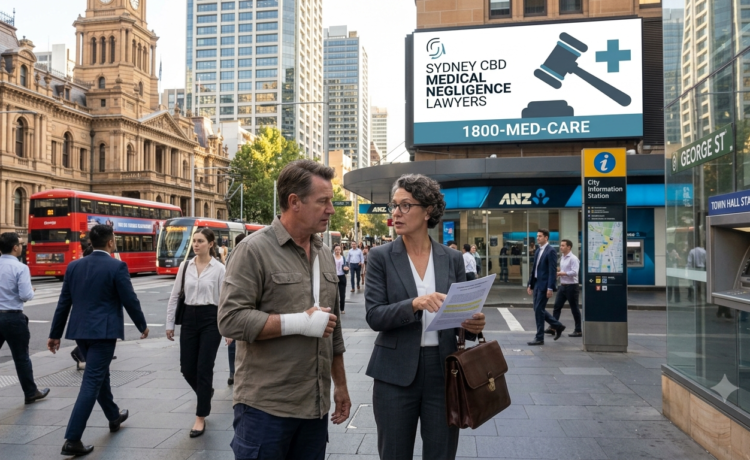
Every year, at least 18,000 Australians sadly lose their lives due to avoidable medical errors. Another 50,000 or so leave hospital with permanent injuries, all as a direct result of substandard care. Despite these alarming statistics, making a medical negligence claim in NSW is one of the toughest legal battles out there. You have to provide most of the evidence. The bar is set high for proof. The whole process can take years, not months, from first looking into it to actually getting a resolution. Medical negligence lawyer Sydney CBD specialists usually start by determining whether there is enough medical evidence to pursue an actionable case.
What Legally Constitutes Medical Negligence in NSW?
You need to prove three things to convince the court that you have a case, duty of care, breach of that duty, and causation. Duty of care is pretty much a given. Every medical professional owes their patients a certain standard of care. That part is usually not in dispute. It’s the breach that’s the problem. That means you have to prove that the treatment you received was below what a competent, properly trained doctor would have done.
Then there’s causation. That’s where you have to show that the poor treatment actually caused the harm, not just that the poor treatment happened at the same time as the harm. A poor outcome after a risky operation isn’t always negligence. There has to be evidence that the doctor made a serious mistake and that mistake led to the injury. All three elements have to be proven. If any one of them isn’t, then your case is sunk.
The Most Common Categories of Claims in Sydney
It’s usually misdiagnosis and delayed diagnosis that end up in court. They are followed by surgical errors, harm picked up in hospital, birth injuries, and doctors not getting proper consent from patients. Claims about birth injuries, especially cerebral palsy caused by a lack of oxygen, are particularly tricky. They often lead to significant payouts when they are successful.
Each type of claim needs its own expert witnesses, its own medical standards, and its own arguments about how the doctor’s mistakes caused the injury. A misdiagnosis case involving cancer treatment needs different medical evidence from a surgical error in orthopaedics.
Why Expert Medical Evidence Is the Backbone of Every Claim?
Medical negligence cases are basically decided by the doctors you present as experts. In NSW, the claimant has to file an expert report with their claim. If you can’t get one of these doctors to say the treatment was substandard, then the case falls apart. Finding the right experts, getting them to support your case, and managing them is a serious job for a specialist lawyer. That’s one of the main reasons why medical negligence claims do much better when the lawyers handling them have genuine specialist expertise in this area.
Time Limits and Why Delay Is Particularly Costly Here
The three-year limit for making a medical negligence claim in NSW starts when you find out, or should have found out, that the doctor made a mistake and that it caused the harm you suffered. That’s not necessarily the date of the treatment. In cases involving delayed diagnosis or injuries that take years to appear, figuring out when you ought to have known can be a real challenge.

What Compensation Is Available and What Affects the Amount?
Medical negligence compensation can vary widely. The range is substantial. Simple claims, where it’s clear what went wrong and how it affected one person, may settle for tens of thousands of dollars. The most serious cases are very different. These involve permanent brain damage, paralysis, or a child left with lifelong care needs after a birth injury. These claims can run into millions of dollars.
The key factors that increase the value of a claim are how severe the injury is, how long it will last, and how much it will affect the person’s life in practical terms. This includes previous earnings, future earning capacity, long-term care needs, and the emotional impact. One of the highest-value claim types is birth injury cases involving cerebral palsy. The lifelong care costs are significant and can often be calculated with reasonable accuracy from an early age.