Among the most researched categories in aesthetic dermatology, laser-based skin rejuvenation has seen steady growth in demand in Australia over the past decade, spanning treatments for photoaging, pigmentation, wrinkles, acne scars, vascular irregularities, and uneven skin texture. But not all laser treatments have the same outcomes, and the distinctions are not subtle. Knowing what each category targets, how it works, and what recovery looks like, is the key to any truly informed treatment decision.
Ablative Resurfacing, The Strongest Results, The Longest Recovery
Ablative laser resurfacing, which uses CO₂ and erbium lasers, removes sections of the epidermis while heating underlying tissue to stimulate collagen production. Studies involving over 1,000 patients showed that ablative procedures produced significantly greater improvements in wrinkles, skin texture, and photodamage compared to less aggressive options. The downside is recovery: patients typically require one to three weeks of visible healing following treatment, and these considerations are at the forefront of many discussions with Neutral Bay laser clinics and dermatology practices throughout Australia.
The benefit of ablative lasers is that they induce significant collagen remodelling in as few as one session. For patients who can tolerate the downtime and desire the most clinically backed outcome for significant skin concerns, the ablative category provides what the evidence supports. For patients who cannot take the time off work or social commitments to have a two-week recovery period, that becomes the make-or-break barrier. Non-ablative and fractional options become more appropriate than compromise choices.
Non-Ablative Systems, Gradual Improvement with Minimal Disruption
Lasers that do not remove the epidermis but instead stimulate collagen production below the skin surface are considered non-ablative and include Nd lasers, fractional non-ablative platforms, and newer wavelength-specific systems specifically designed for photorejuvenation. Systematic reviews have reported recovery times from hours to days, and most patients can return to normal activities in 24 to 72 hours after treatment, compared with recovery times of weeks after ablative treatment. The disadvantage is that the improvements occur gradually over several treatments. Clinical protocols typically require three to six treatments to achieve results comparable to a single aggressive ablative procedure.
That comparison is an important one to keep in mind when considering non-ablative treatment courses. It is truly effective for fine lines, early signs of aging, open pores, and roughness. It is not a gentler form of ablative resurfacing that simply produces a less dramatic result at a longer interval. It is a different mechanism that produces a different scale of change over a longer timeline. Patients who seek ablative results from non-ablative parameters are approaching it from a misunderstanding of the technology and what it is intended to do. Their expectations drive satisfaction more than the treatment itself.
Fractional Technology Is the Middle Ground That Changed the Field
Fractional laser systems altered the clinical calculus of skin resurfacing by treating only a fraction of the skin surface during each session. This allows the surrounding tissue to heal without delay. Clinicians can calibrate treatment to patient goals and tolerance, with ablative and non-ablative types. Clinical reports have noted significant improvements in skin texture, fine lines, pigmentation, and acne scars. Healing times are markedly less than with fully ablative resurfacing, though this is not always as short as marketing would suggest. Untreated skin remains between the laser columns.
Picosecond Lasers and Targeted Systems for Specific Concerns
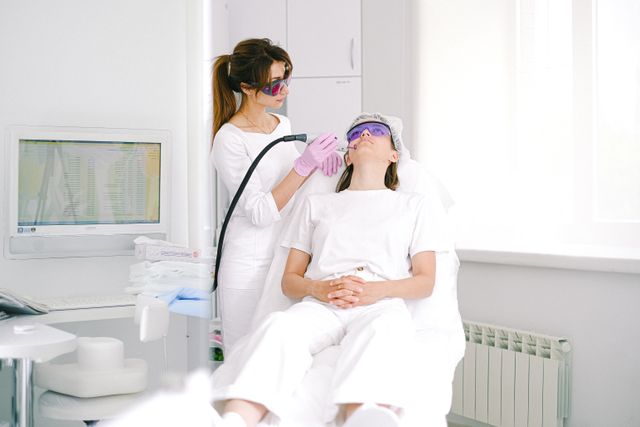
Picosecond lasers provide energy in trillionths of a second and thus have a higher photoacoustic effect, which minimises thermal damage to surrounding tissue. Although initially designed for tattoo removal, 1064-nm picosecond systems are now commonly used for pigmentation management and skin quality improvement. Prospective clinical studies have demonstrated efficacy for melasma, photodamaged skin, and skin texture after a course of treatments, especially with their reduced heat profile. This makes them particularly appropriate for darker skin types, where heat-induced complications from some traditional systems may be more significant.
Other signs of ageing are not caused by loss of collagen, and vascular and pigment-specific systems fill in the gaps. The right laser for a patient is ultimately determined by what their skin actually needs, not by which category is most prominently marketed. Pulsed dye and KTP lasers are used to treat facial redness and visible vascular lesions because they take advantage of the presence of haemoglobin in blood vessels. Q-switched and picosecond devices that are targeting melanin-containing structures can dramatically reduce solar lentigines, age spots, and chronic UV-induced uneven pigmentation.